
To What End – William Kentridge
Related products


Product detailed description
The Rubrics series is part of William Kentridge’s long-term practice, in which he works with short textual fragments – sentences, notes, or snippets of thought recorded in his sketchbooks. These texts are neither conventional statements nor self-contained messages. They are fragments captured on the edge of meaning – sentences that seem familiar yet remain ambiguous. They may resemble snippets of poetry, marginal notes, or sentences torn from a broader context that is no longer accessible. These phrases become the starting point for visual compositions where words transform into images and images back into thought.
Kentridge understands them as a kind of “headings” – similar to those in medieval manuscripts, where the red text did not contain the prayer itself, but instructions on how to read or experience it. His own texts thus function more as prompts for thought than as finished statements – they guide attention but do not define meaning.
Colour also plays an important role here. Kentridge began painting his texts in, among other things, the intense blue of the natural pigment lapis lazuli, which defies reproduction due to its depth and physical presence. It was precisely this colour that became a way for him to “make the text visible” – to transfer it from language to image and give it a new sense of urgency.
Each silkscreen is created as a combination of layering and typographic elements, often on found or specific papers. Kentridge works with substrates that already carry their own history, for example, pages from old books, 18th-century religious texts, or 19th-century astronomical records. These materials originally served to systematize knowledge, to name, classify, and explain the world. They enter the final work with their structure, traces of time, and original meaning, which shifts in the new context.
The colour, whether red or blue, is not merely an aesthetic choice, but part of a visual language that highlights the tension between meaning and form.
The result is a collectible object that exists at the intersection of printmaking, drawing, and conceptual art – a characteristic example of Kentridge’s ability to connect personal gesture with broader cultural and historical contexts. Each piece functions as an autonomous work while also forming part of a larger whole. Rubrics are not illustrations of a fixed message – rather, they open up space for interpretation and active reading of the image.
| Artist | William Kentridge |
| Series | Rubrics |
| Title | To What End |
| Year | 2019 |
| Technique | Lapis Lazuli pigment screen print on found paper from Royal Observatory, Cape of Good Hope |
| Dimensions | 32.3 x 40.3 cm |
| Edition | 20 pieces (number 6 is available at Kunsthalle Praha) |
William Kentridge
William Kentridge (*1955, Johannesburg) is one of the most important contemporary artists. His practice spans drawing, printmaking, film, animation, theatre, and installation, and consistently explores the relationship between image, time, and memory.
His work is deeply shaped by the historical and political context of South Africa, particularly the era of apartheid. Kentridge addresses themes such as power, injustice, collective memory, and human responsibility, often working through fragmentation, repetition, and shifting meaning.
Drawing plays a central role in his process as a living, evolving medium – images are never fixed, but continuously erased, redrawn, and transformed. This openness and layered approach make his work a powerful and timeless reflection on the world around us.
Additional parameters
| Category: | Limited editions |
|---|---|
| Weight: | 4.1 kg |
| Artist: | William Kentridge |
| Categories: | silkscreen prints |
| Products: | limited editions |
Discussion
Be the first who will post an article to this item!
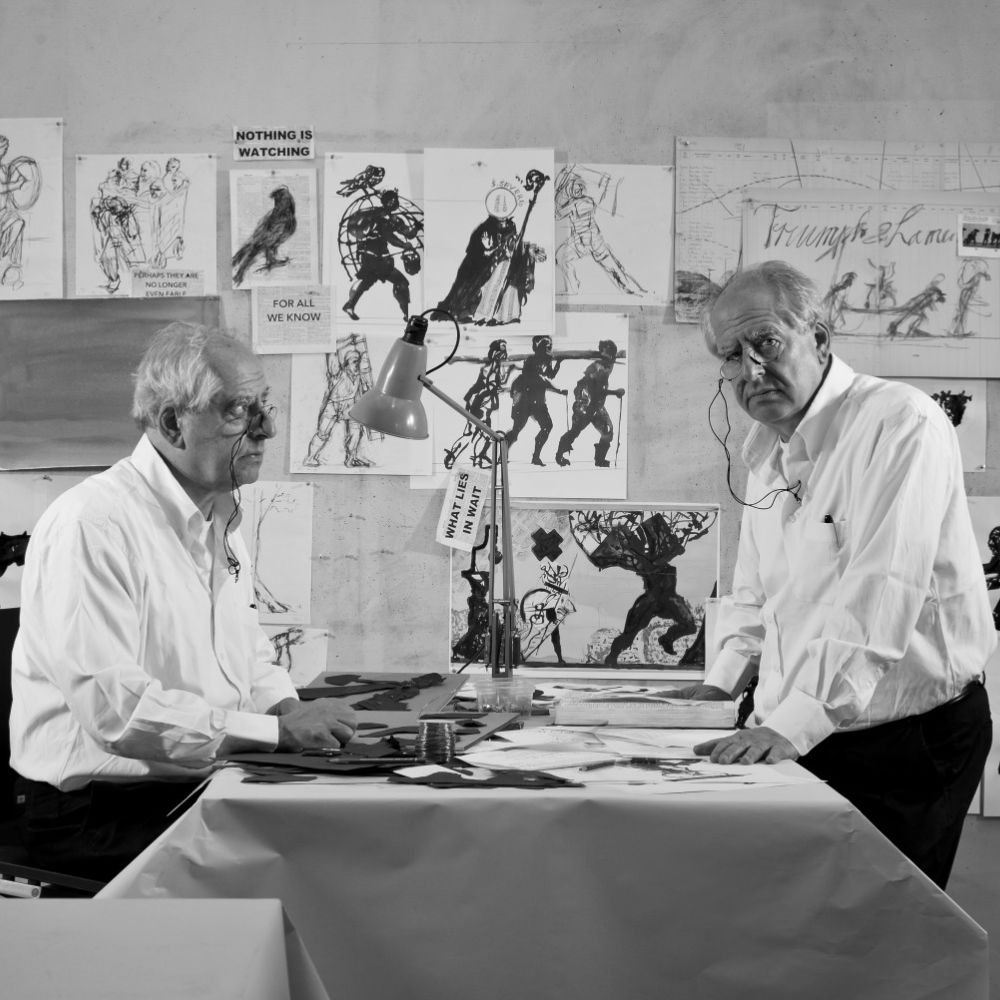
William Kentridge is a South African artist internationally renowned for his drawings, prints, and pioneering animated films. He became widely known in the 1990s for his hand-drawn animation technique based on drawing, erasing, altering the image, and filming each stage — a process that leaves visible traces of change and has become his unmistakable artistic signature.
Kentridge’s work explores themes such as memory, history, colonialism, and the political complexities of South Africa. His pieces function as poetic visual essays, combining the tactility of drawing with the narrative depth of film.
Today, Kentridge is considered one of the most influential contemporary artists worldwide. His work has been exhibited at Tate Modern, MoMA, the Venice Biennale, and Documenta, among many other major institutions.