
Gregor Hildebrandt has been interested in skateboarding from an early age. It has significantly influenced his sense of aesthetics and has become a form of artistic expression for him. He has now begun collaborating with the platform The Skateroom, which reinforces and inspires social change for the benefit of disadvantaged young people. The organisation’s motto is: “We value art. We value skate.”
The Skateroom group collaborates with the most influential contemporary artists, museums, and foundations. For example, in the past their name has been linked with Keith Haring, Cindy Sherman, and the photographer JR. The results of their collaboration comprise skateboard boards that are more collector’s items rather than boards for the street. A part of the profits from each collection goes towards financing new skateparks and charitable educational programmes.
The Skateroom and Gregor Hildebrandt share an important belief, specifically that there is an intrinsic link between skateboarding and art. Skateboarding, as a form of art, can change lives and offers space for creativity. An idea is a secret, a mysterious image, which a skateboarder keeps turned towards the ground during his ride and only reveals when performing the right trick. In order to ensure proper functionality, the top of a standard skateboard is covered with griptape, but the reverse side provides its entire space for creativity and self-expression. Today, Gregor Hildebrandt views the skateboard chiefly as his artistic canvas, but in his skating years he knew a few tricks, including the kickflip. During this trick, the skateboard turns 360 degrees while up in the air, and – for a second – reveals the secret concealed on its underside.
Discover both the Barta Board and Black Barta Board editions here.
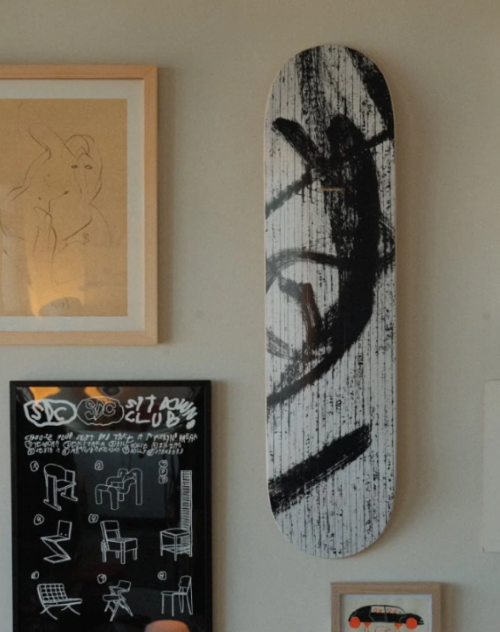
Gregor Hildebrandt’s art is closely linked to music. He and his partner, Alicja Kwade, established the Gregorzski Records label, which supports young emerging artists. In his work, the Berlin-based artist often explores analogue storage media and whether it is possible to weave music into a visual work. Music also lies hidden in the collection of skateboards. The images on them are made using the rip-off technique, when both a positive and a negative version of the same image are created. Gregor Hildebrandt uses the magnetic tape from carefully selected cassettes, which he first attaches with the help of an adhesive then subsequently rips off, attaching the remnant to the second skateboard of a pair. The songs “recorded” on skateboards in this way contain references to his coming of age, skateboarding, freedom, and rock music.
The songs “Madonna’s Dickdarm” from Die Ärtze and “Can You Tell Me One Thing” from The Organ contained in the collection of skateboards can only be supplemented with the sound of wheels on the pavement, an intimately familiar and playful sound. Maybe this collaboration will bring Gregor Hildebrandt back to skateboarding, or just maybe it will lead you to taking it up.
The charity that will be supported by the collection and Gregor Hildebrandt is Skateistan, which provides a space on earth for all children who will most probably not be able to return to school for a long time because of war or various environmental catastrophes. Whether they are the children of refugees, children with disabilities, or simply children who are in danger, at Skateistan they can learn, play and continue to dream, ride their skateboards in peace, and gain an education.