
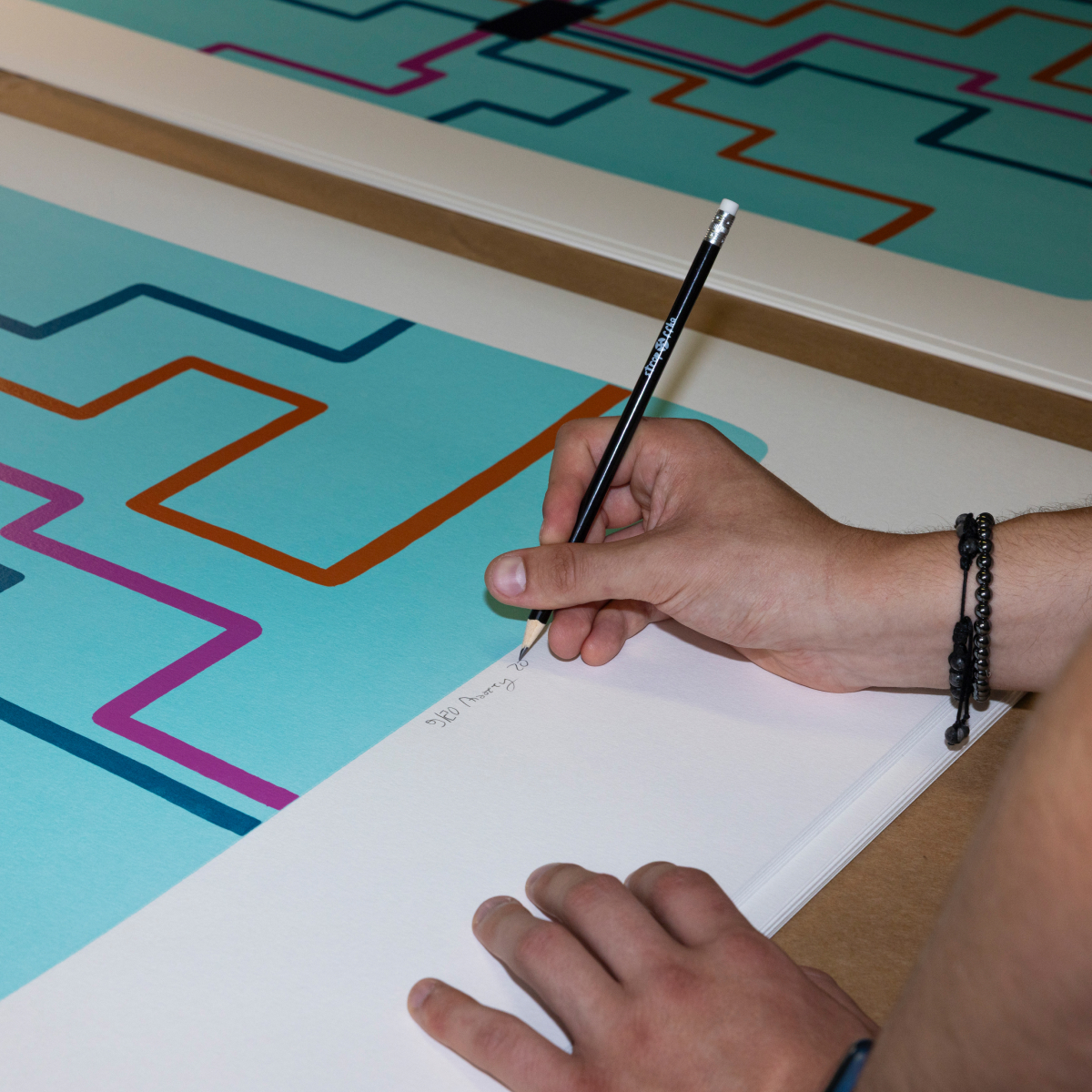
“Art helps me a lot to calm down. I immerse myself in my inner world and come up with different routes and shapes,” Matěj Hošek, known artistically as Maatty, tells us in our interview. The twenty-year-old artist, who has autism, was included in the Forbes 30 Under 30 ranking in 2025. Before turning to painting and lithography, he drew maps of Prague’s public transport system from an early age – a passion that continues to find its way into his characteristic lines. For Kunsthalle Praha, he created the limited edition High Voltage, inspired by the building’s history as a former electrical substation. In our interview, he reveals what creating means to him, what inspires him, and how he sees the world around him.


About the High Voltage Limited Edition
What inspired you to create this edition for Kunsthalle Praha?
Maatty: Without a doubt, the fact that Kunsthalle Praha is a former substation for supplying electricity. I thought the black cube in the centre could symbolise the building itself. The various intricate arteries then represent electricity, the energy spreading from the building into its surroundings – much like Kunsthalle Praha works by extending its art out into the wider world, not only across Prague and the Czech Republic, but internationally as well. I wanted there to be a connection between energy, art and society.


A Passion That Became a Visual Language
Your work features recurring motifs and clean lines. What generally inspires you most in your work?
Maatty: Definitely my passion for public transport, which I’ve had since childhood, as I spent a long time working on different maps. Then I moved not only towards lithography, but also towards paintings that use the symbolism of linear abstraction. Pablo Picasso was often an influence of mine because of Cubism, and from the Czech scene there is Zdeněk Sýkora, who created art similar to what I’m doing now, as well as Piet Mondrian, who also explored linear abstraction through colour. My use of colour can sometimes be quite random, but it definitely has its own logic. I like experimenting with several different colours so that they catch the eye through their visual impact and energy.
When Abstraction Was a Revolution
You like Tomáš Bím. Which other artists, whether local or international, are your influences?
Maatty: Although I don’t focus that much on contemporary artists, in the field of lithography it’s Tomáš Bím, but also artists such as Kamil Lhoták or Jiří Slíva, whom I met at the lithography workshop on Říční Street – that’s where I met most of the legendary artists.
When we talk about the artists I like most, they tend to be those who worked in the 20th century – pre-war and interwar artists, whose work was revolutionary from the perspective of abstraction. Zdeněk Sýkora, for example, was one of the first artists to incorporate computer graphics, or rather the principles behind them, into his paintings. I do something similar – I first create designs using digital graphics and then translate them into physical works.
Calm and Freedom in Art
How does autism influence your work? How does it help you, and what is the biggest challenge for you?
Maatty: Autism has been a major lifelong challenge for me – not only in terms of being part of mainstream society, but also in the way I perceive my surroundings through the lens of this condition. Art helps me a lot when it comes to calming myself down. I immerse myself in my inner world and come up with different routes and shapes so that they fit naturally into my artistic state of mind. These shapes often don’t have any logic or meaning, but I try to encourage people to find their own logic and context in my work.
Of course, I don’t only create purely random things. Some works have a clearly defined system and represent something specific – for example, world maps or a particular shape. But I want people to find their own meaning through their imagination when they look at a work and discover what exactly it represents. They can also look at a caption that I have created, but at the same time I want them to find something of their own in it – and for me, that is precisely what freedom in art is about.
When you look at a landscape, you see a landscape; you don’t look for anything else in it. The advantage of abstraction is that you can find many different things within it. Yes, it can make your head spin if you think about it too much, but on the other hand, it’s good to immerse yourself in it rather than simply look at it and walk away. I want people to spend more time looking at a work, to discover its context as well as the point and function of the painting or graphic print.

About Family
You have wonderful parents who support you. What would you like to say to them?
Maatty: I would definitely like to highlight my mum, who has not only sacrificed a lot to help me get to where I am today – to become part of mainstream society, but also to achieve something I might not have been able to achieve without her. To become an established artist and to keep developing further and further. She helps me come up with some of my ideas, and most of them actually come from her side. I’d also like to thank my dad, who helps me not only with presenting my work, but with everything in general.
About the Artist
MAATTY (Matěj Hošek) is one of the most distinctive young names on the contemporary Czech art scene. Living with autism, he has used lines as his natural language since childhood – first drawing public transport maps for pleasure, which later developed into a distinctive visual system built around rhythm, repetition and geometry. Precise shapes and structures have always served as a way for him to organise his thoughts and find calm, and it is from this combination of order and emotion that his current practice emerges, bringing architectural precision together with deeply personal content. His work loosely follows in the footsteps of artists such as Piet Mondrian and Zdeněk Sýkora, while his own visual language remains unmistakable. In 2025, he was included in the Forbes Czech 30 Under 30 ranking, recognising not only his artistic achievements but also his story.